
All Guides
Eternal Palace Sakura Combat Basics: AP, Arts & Tension
How AP, Arts, Tension, Over Arts, dodge, shield, and Burst work in Eternal Palace Sakura—with sourced basics from GameWith and English reviews.
Eternal Palace Sakura is a 3D action roguelite where fights reward chaining normal attacks, spending AP on Arts, and managing Tension, defense, and Burst under pressure. This guide summarizes the combat loop described in GameWith’s walkthrough, the NoobFeed review, and official Steam combat imagery—not unverified player tier lists.
For input bindings, see the dedicated controls guide. For individual skill names and unlock notes, use the Arts list. Depth scaling that makes later rooms harder is covered under Mugen Depth; Area 1’s floor boss is Beastfang Maru (牙獣丸).
What is the basic attack loop?
Sources describe light (weak) and heavy attacks that can be chained by repeated inputs—GameWith maps light and heavy to mouse buttons on PC, while the NoobFeed review emphasizes cancel-friendly combo routes into Arts.
Normal attacks are the primary way to earn AP. Official screenshots show an AP n/m readout at the bottom of the HUD (for example AP 1/6 or AP 3/4 in captured frames—those numbers are one screenshot each, not fixed maximums for every build). The same HUD frames also show Bonus Rate percentages during combos.
How many Arts can you equip, and what do they cost?
Walkthrough and review coverage consistently states you can equip up to four Arts at a time, chosen as you progress a run. Each Art spends AP when used; low-AP skills are easier to weave between normals, while higher-AP finishers hit harder but demand more setup.
GameWith assigns keyboard slots Q, E, R, and F for Arts on PC. Controller layouts in English reviews describe bumper-plus-face-button or bumper-plus-trigger combinations instead of a single face button per Art.
The Arts list tracks verified names where Steam achievements or HUD text confirm English UI strings. Many beginner picks still appear in Japanese walkthrough text only.
What are the cancel rules between attacks and Arts?
According to the NoobFeed review, you can cancel normal → heavy → Arts, heavy → Arts, and Art → Art within the combo system. That structure is why AP generation and timing matter: you are not locked into long recovery animations if you spend AP at the right moment.
Pair this with the Bonus Rate meter shown in official HUD shots—NoobFeed notes that landing hits inside the combo window raises Bonus Rate faster, which supports sustained Arts use when you stay offensive.
How do status ailments stack in combat?
The same English review states that repeated elemental hits stack status ailments up to level 5. We do not yet have a public, verified table of every ailment name and effect at each level; treat level 5 as the cited cap, not a promise that every element behaves identically.
What does the Tension Gauge and Over-Tension do?
Marketing copy and walkthrough text refer to a Tension Gauge that fills as you fight. GameWith lists Over-Tension (オーバーテンション) activation at 100% gauge fill—on keyboard, Z when the gauge is maxed in their control summary.
While Over-Tension is active, sources describe faster AP recovery and access to Over Arts (オーバーアーツ)—high-impact finishers shown in official footage with large hit counts and damage totals on screen.
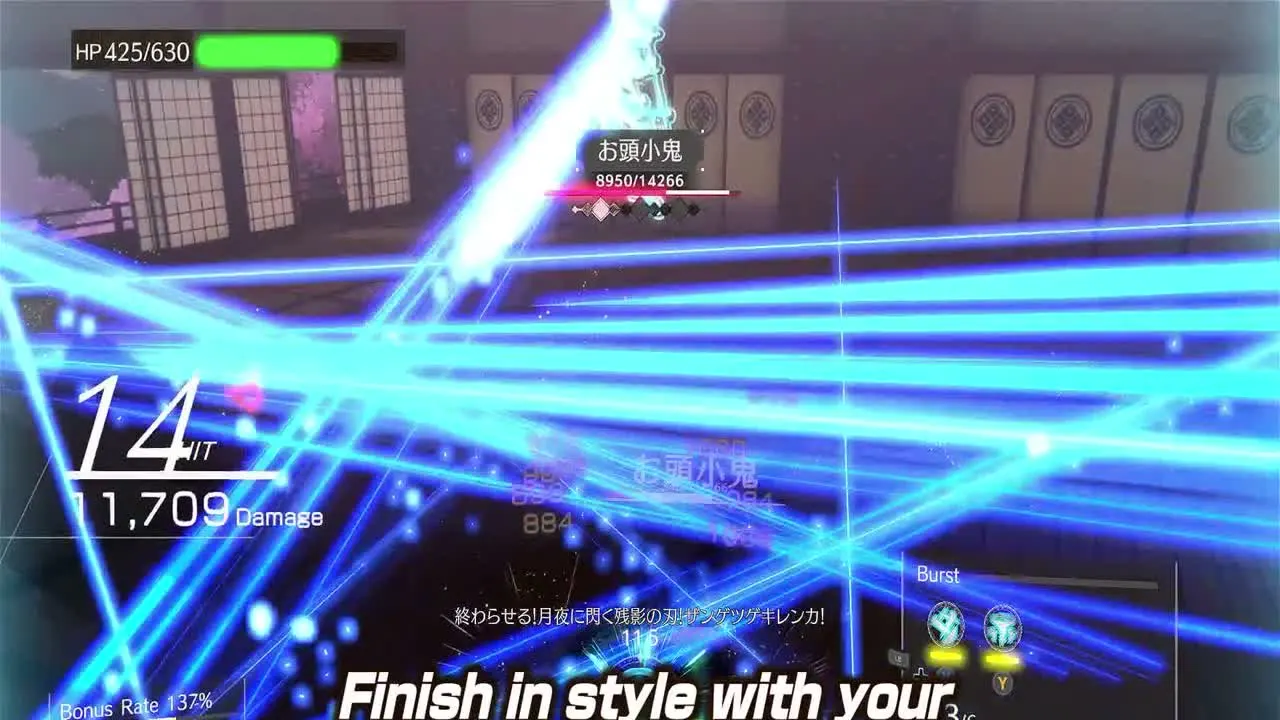
Frame from the official English release trailer. Hit counts and AP shown are examples from that clip.
What are Over Arts in practice?
Over Arts are the cinematic finishers associated with a full Tension Gauge and Over-Tension state. Trailer and screenshot material shows multi-hit damage spikes and on-screen attack captions.
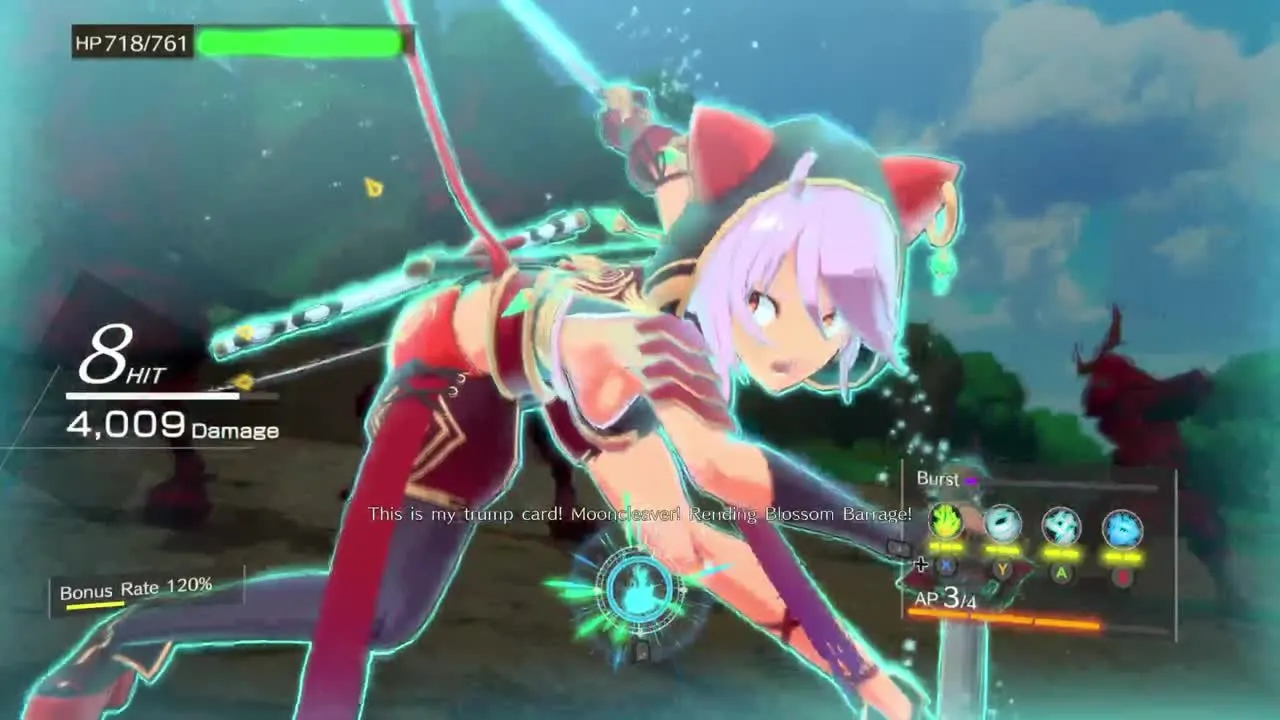
Official Steam screenshot. The caption Mooncleaver! Rending Blossom Barrage! is on-screen flavor text in this frame, not a verified official English Art name in our achievement or store extracts. Do not treat trailer or screenshot captions as codex names unless paired with UI or Steam achievement text.
How do dodge and perfect dodge work?
NoobFeed describes dodge options including backstep, sidestep, and dashing through enemies. Perfect Dodge—timing a dodge to avoid damage—restores AP and briefly slows nearby enemies and projectiles, giving you space to continue a combo or reposition.
GameWith maps dodge to Space on keyboard in their PC table; confirm your platform in controls.
How does shielding, perfect block, and Burst interact?
Shield / barrier is a held block in GameWith’s PC layout (Left Shift). Their walkthrough states you hold block until shield durability breaks, and broken durability does not recover during that run—plan blocks as a limited resource, not a regenerating bar.
NoobFeed adds Perfect Block: a well-timed block restores AP, keeps the shield from taking the hit, and enables a counter response. Official HUD frames label a Burst gauge near the AP bar; the review describes filling Burst while blocking and spending it for knockback when surrounded (Shield Burst-style relief).
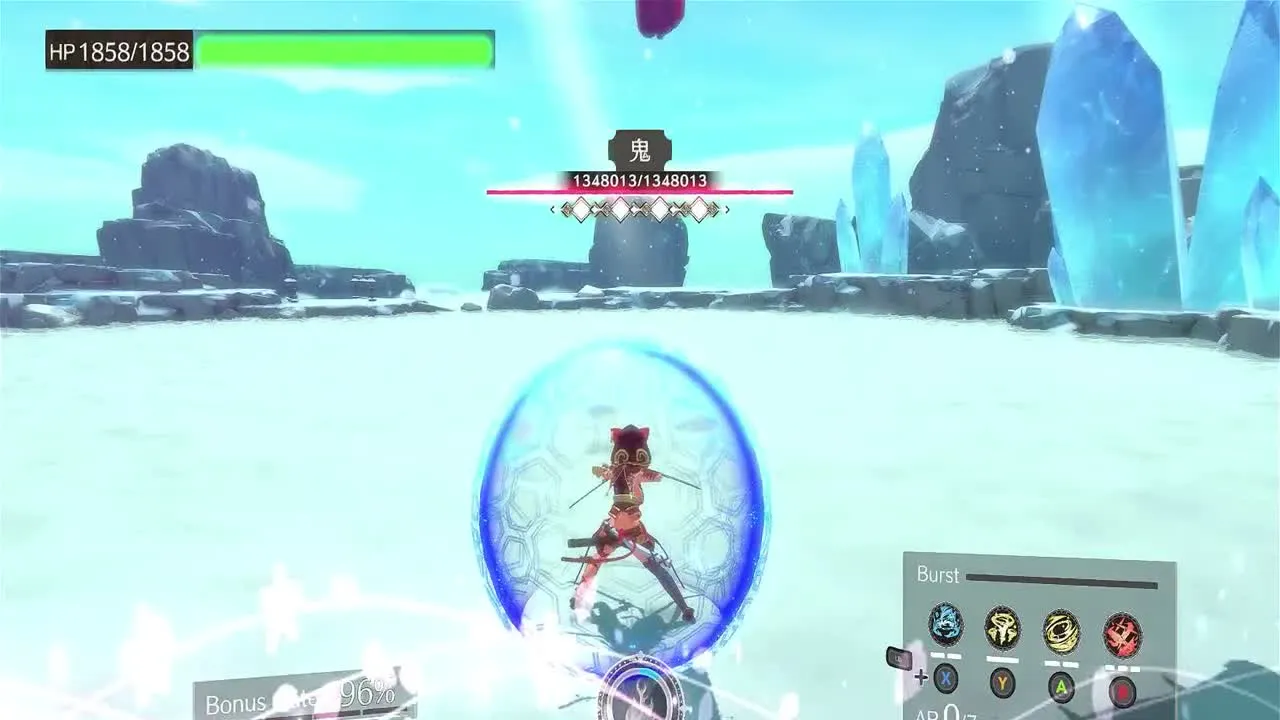
Official English trailer frame. Enemy name 鬼 and partial Japanese UI appear as captured; numbers are one moment in the clip.
Is there lock-on, and can you jump?
After demo feedback, sources including GameWith’s developer interview coverage and NoobFeed cite lock-on on RB in an Xbox-style layout. Use lock-on for mobile elites and bosses such as Beastfang Maru (牙獣丸) when the camera struggles to keep up.
NoobFeed explicitly notes no jump and no aerial combos, which matches a grounded, arena-style slash system. If a future patch adds vertical movement, this page should be updated with a verified control screen.
How does combat connect to run difficulty?
Mugen Depth rises as you take map actions, buffing enemies and applying Depth Effects to the player in sourced walkthrough examples. Combat rooms are also where GameWith states level-ups occur—shops and events are not leveling venues in their description.
When learning the loop, practice AP routing and defensive timing in early combat rooms before Depth effects compound in later floors.
Sources and verification
Sources used: GameWith walkthrough — PC bindings, shield durability rule, Over-Tension key, four Arts, AP from attacks; NoobFeed review — cancel routes, Bonus Rate and ailment stacking, dodge and perfect dodge/block, Burst knockback, lock-on, no jump, tentative Tension carryover; Steam store page — combat marketing and screenshot HUD; frames from the official release1105_EN trailer (the Over Arts and shield moments).
Still not verified on this page: Exact AP maximums per build, full ailment list at levels 1–5, Tension carryover between floors (single reviewer), complete controller binding chart from an in-game Options screen, and English codex names for every Art shown only as screenshot captions.
FAQ
How many Arts can I equip at once in Eternal Palace Sakura?
What triggers Over-Tension?
Does a broken shield recover during a run?
Can Retla jump or do aerial combos?
Does Tension carry over between floors?
Related Articles
-
guides
Eternal Palace Sakura Achievements: 67 Total, Partial Name List
Steam lists 67 achievements for Eternal Palace Sakura. Here are the Art and Attribute unlock names we could confirm, with Japanese pairs where available.
-
guides
Beginner Guide - Your First Run in Eternal Palace Sakura
How one Eternal Palace Sakura run works: branching map rooms, post-fight rewards, save rules, demo on Steam, and what to learn first—without unverified tips.
-
guides
Best Starter Arts & Attributes in Eternal Palace Sakura
Early Arts and Attributes GameWith and English reviews suggest for Eternal Palace Sakura—compiled with sources, not a wiki tier list or hands-on ranking.
Was this helpful?
Thanks for the feedback!